


Discover›Spirits guide
Calvados & Lambig
Normandy’s apple brandy, and its Breton cousin
Calvados is a brandy distilled from cider, made with apples and perry pears from Normandy and aged for at least two years in oak. Brittany makes its own cider brandy, lambig. Here is how both are made, what ‘Pays d’Auge’ or ‘VSOP’ on the label means, and how to taste them.
A short history
From farmhouse spirit to appellation
Normandy has pressed apples for cider since the Middle Ages and distilled it for almost five centuries. Long a farmhouse spirit, cider brandy took the name of a département, won France’s first appellation for a cider brandy and became one of the country’s great brandies.
- 1553In the Cotentin, the squire Gilles de Gouberville notes in his diary that cider is being distilled: the first written mention of Norman cider brandy.
- 1606Normandy’s cider-brandy distillers form their own guild. Later, to protect the wine-brandy trade, the Crown taxes their spirit and then bans its sale outside Normandy until 1741.
- 1790The Revolution creates the département of Calvados, named after a line of rocks off its coast. By the 1880s, Flaubert, Zola and Maupassant simply call the spirit calvados.
- 1942With alcohol being requisitioned to make explosives, Normandy’s cider brandies are protected by appellation, and Calvados Pays d’Auge becomes the first cider brandy with an AOC.
- 1963Brittany’s cider brandy, lambig, gets an appellation of its own. Today it is an AOC that may also be called Fine Bretagne.
- 1997After AOC Calvados in 1984, Calvados Domfrontais, the pear-rich calvados of the Domfront area, completes today’s three appellations.
How it’s made
From orchard to glass: eight steps
Calvados begins in the orchard and spends years in oak before it reaches the glass. Every stage, from the trees to the stills, is set down in the appellation rules.
01
High-stem orchards
Calvados is made from cider fruit, not eating apples. The traditional Norman orchard is a meadow planted with tall, widely spaced ‘high-stem’ trees: cattle graze beneath the branches, and the ripe fruit falls into the grass to be gathered in autumn.
Lower, denser orchards have spread since the 1970s, but the rules still ask for at least 35% of the fruit to come from high-stem trees for AOC Calvados, and 45% for Pays d’Auge. Around Domfront, tall perry pear trees stand among the apples.
≥ 35%of the fruit from high-stem trees (AOC Calvados)
02
Sweet, bitter, sharp
Cider apples are small and often too bitter or too sour to eat. Growers sort them into four families: sweet, bittersweet, bitter and sharp. Bitter apples bring tannin and body, sharp ones freshness, sweet ones the sugar for fermentation.
Cider for calvados is always a blend of many varieties, and at least 70% of the apple trees in an AOC orchard must be bitter or bittersweet. Perry pears may make up to 30% of the fruit in Pays d’Auge and at least 30% in Domfrontais, where they give a finer, more floral spirit.
≥ 70%of apple trees bitter or bittersweet
03
Milling & pressing
Once ripe, the fruit is washed, sorted and crushed in a mill. The pulp is then pressed, traditionally in layers separated by cloths or straw, to release a cloudy, sweet juice.
Some producers let the pulp rest for a few hours before pressing, so the juice gains colour and aroma. Yields are capped too: for AOC Calvados, no more than 25 tonnes of fruit per hectare.
25 tof fruit per hectare at most (AOC Calvados)
04
A slow, dry cider
The juice ferments with its own yeasts, slowly and without added sugar, until the sugar has turned to alcohol. The result is a still, dry cider of around 5%, quite unlike the sweet sparkling cider sold in bottles.
The rules ask for at least 21 days between pressing and distillation, and the cider must reach at least 4.5%. Many producers wait much longer and distil through the winter and spring: a long, cool fermentation builds the fruity aromas that carry into the spirit.
21 daysat least from pressing to distillation
05
Twice in copper
Calvados Pays d’Auge must be distilled twice in a copper pot still, like cognac. The first run turns the cider into ‘petites eaux’ of around 30%; the second separates the heads and tails and keeps the heart, at around 70%.
The stills are small, with at most 25 hectolitres of cider per run, heated over a direct fire or by steam. Double distillation gives a rounder, more complex spirit that needs longer in oak to show its best. It is allowed, but not required, for AOC Calvados.
≈ 14 Lof cider for 1 L of calvados at 70%
06
One column
Most calvados is made in a continuous column still. The cider flows down over a stack of copper plates while steam rises through it, carrying alcohol and aromas to the top, where they are condensed in a single, unbroken run.
The spirit comes off at 72% or less, so it keeps plenty of fruit. The column is compulsory for Calvados Domfrontais, where it brings out the freshness of the pears; Brittany’s lambig may be distilled either way.
72%maximum strength off the still
07
Years in Norman oak
The new spirit goes into oak casks and large vats, often old ones that give more air than wood flavour. In the mild, damp Norman climate it softens slowly; each year a little evaporates, the angels’ share, and the colour deepens from pale straw to amber and mahogany.
Calvados must spend at least two years in oak, three for Domfrontais. Before bottling, the cellar master blends casks of different ages and slowly brings the strength down with water to 40% or more.
2 yearsminimum in oak (3 for Domfrontais)
08
Reading the age
Calvados labels use the same words as cognac but with their own minimums, always counting the youngest spirit in the blend: VS or three stars at 2 years, Vieux or Réserve at 3, VSOP, VO or Vieille Réserve at 4, and XO, Hors d’âge, Très Vieille Réserve, Extra or Napoléon at 6.
An age such as ‘12 years’ also refers to the youngest calvados in the bottle, while a vintage comes from a single year. ‘Fine’ usually marks the youngest calvados, two years old, made for mixing.
6 yearsminimum for XO and Hors d’âge
Styles
Three calvados, a Breton cousin and more
The appellation, the share of pears, the still and the years in oak all shape the glass. These are the styles you are most likely to meet.
Calvados
The broad appellation, covering most of Normandy and some 70% of all calvados. Usually column-distilled, fresh and fruit-forward, with crisp apple first; double distillation is allowed too.
Calvados Pays d’Auge
From the heart of Normandy’s cider country, east of Caen, and always double-distilled in pot stills. Richer and more complex, it rewards long ageing. On our shelves: Sausseux VSOP, XO and 12 years.
Calvados Domfrontais
Pear country in the south of Normandy: at least 30% perry pears, column-distilled and aged for three years or more. Floral and delicate. After the storm of December 1999 felled much of the old pear orchard, nearly 20,000 trees were replanted.
Young calvados
VS, Fine or three-star calvados is all about fresh fruit. Pour it over ice with tonic, use it in cocktails, or serve it as a trou normand between courses.
Old calvados
XO, Hors d’âge and age statements of 10, 15 or 20 years trade fresh apple for baked apple, dried fruit, spice and leather. Sip it neat after dinner. On our shelves: Sausseux XO and 12 years.
Lambig (Fine Bretagne)
Brittany’s cider brandy, made only from Breton cider apples and aged at least two years in oak. ‘Lambig’ is the Breton word for a still. On our shelves: Fine Bretagne Glycine and Étoile.
See our lambigs →Pommeau
Not a brandy but an aperitif: fresh apple juice stopped from fermenting with calvados, then aged at least 14 months in oak, at 16 to 18%. Pommeau de Normandie is an AOC, and Brittany has its own.
Other cider brandies
Cider brandy made outside the calvados rules is sold as eau-de-vie de cidre de Normandie, and neighbouring Maine has its Fine du Maine. In the United States, apple brandy is known as applejack.
The rules
What the label means
Calvados has three appellations, and Brittany’s lambig one more. The headline rules, simplified:
Calvados
AOC since 1984
- Cider or perry from the appellation area, at least 4.5% when distilled
- At least 70% bitter or bittersweet apple trees; at least 35% of the fruit from high-stem orchards
- At least 21 days from pressing to distillation
- Copper stills, column or double distillation, to 72% or less
- At least 2 years in oak; bottled at 40% or more
Calvados Pays d’Auge
AOC since 1942
- Made in the Pays d’Auge
- Perry pears: at most 30% of the cider
- At least 45% of the fruit from high-stem orchards
- Double distillation only, in copper pot stills of at most 25 hl per run
- At least 2 years in oak; bottled at 40% or more
Calvados Domfrontais
AOC since 1997
- Made around Domfront, in the Orne, Manche and Mayenne
- At least 30% perry pears
- Column still only, to 72% or less
- At least 3 years in oak
- Bottled at 40% or more
Lambig
AOC Eau-de-vie de cidre de Bretagne
- May also be called Fine Bretagne or Lambig de Bretagne
- Breton cider apples only, from the five departments of historic Brittany
- Distilled in copper stills to less than 72%
- At least 2 years in oak; 10 years for a vintage
- Bottled at 40% or more
A simplified summary; each appellation’s rules go into more detail. The age words (VS, VSOP, XO…) follow the minimums in step 8. Pommeau de Normandie and Pommeau de Bretagne are AOCs too, and cider brandy made outside these rules is sold under EU law as ‘cider spirit’, at 37.5% or more.
Words to know
A short calvados glossary
- Calva
- The everyday Norman name for calvados, as in café-calva: a coffee with a shot of calvados on the side.
- Cider apple
- Pomme à cidre: a small, tannic or acidic apple grown for cider rather than for eating.
- High-stem
- Haute-tige: tall fruit trees planted far apart in grazed meadows, the traditional Norman orchard.
- Perry pear
- Poire à poiré: a hard, tannic pear grown for perry and for Calvados Domfrontais.
- Petites eaux
- The weak spirit, around 30%, from the first distillation of cider in a pot still.
- Alambic à repasse
- A pot still used for double distillation, the method required for Calvados Pays d’Auge.
- Compte d’âge
- The official age count of a calvados, always that of its youngest spirit.
- Bouilleur de cru
- A grower who distils the fruit of his own orchards, a long tradition in Normandy and Brittany.
- Trou normand
- A small glass of calvados, or today often a calvados sorbet, served between courses to ‘make room’ for the rest of the meal.
- Pommeau
- Apple juice and calvados aged together in oak: an aperitif of 16 to 18%.
How to taste
Five steps to taste calvados
- The glassA tulip-shaped glass at room temperature. Young calvados can also be served chilled or over ice.
- LookFrom pale straw for a young VS to deep amber and mahogany after many years in oak.
- NoseYoung calvados smells of fresh and baked apple, pear and blossom; older ones of tarte Tatin, dried fruit, vanilla, spice and leather.
- TasteLet it rest on the tongue: the apple stays at the heart even in very old calvados. A pear-rich Domfrontais feels lighter and more floral.
- At the tableA trou normand between courses, an old calvados with coffee, or a glass alongside apple tart, Camembert or dark chocolate.
Want to compare a young calvados with an old one? Come and taste with us at the shop: we’re happy to help you choose.
Plan your visit →In our shop
Calvados & lambig on our shelves
Calvados Pays d’Auge from Sausseux, VSOP, XO and 12 years, and two Breton lambigs, Fine Bretagne Glycine and Étoile. Collect them at the shop or get free local delivery.
-
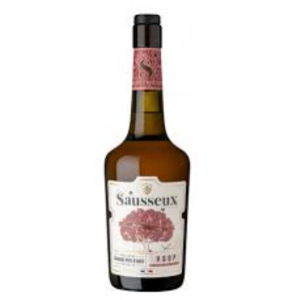
SAUSSEUX VSOP AOC CALVADOS PAYS D’AUGE 0.7l 40%
€20.95 Add to cart -

SAUSSEUX XO AOC CALVADOS PAYS D´AUGE 0.7L. 40%
€34.50 Add to cart -

SAUSSEUX 12 ANS AOC CALVADOS PAYS D´AUGE 0.7L. 40%
€65.95 Add to cart -

AOC Fine Bretagne cuvée Glycine 0.7l 40%
€20.95 Add to cart -

AOC Fine Bretagne Cuvée étoile 0.7l 43%
€28.95 Add to cart